How to Choose a Temperature Cycling Chamber for Sale?
Need a temperature cycling chamber for IEC 60068-2-14 testing? Request a quote in 24 hours.
When buying a temperature cycling chamber, it is more important to ensure that the ramp rate, internal volume, and control accuracy meet the requirements of your test protocol than simply choosing the cheapest option. A reliable temperature cycling chamber manufacturer should provide clear specifications for heating and cooling performance, which typically range from 5°C to 15°C per minute, while maintaining temperature control accuracy within ±0.5°C and temperature variation within ±2.0°C.
Buyers should also check the sensor grade, as PT100 Class A sensors generally provide higher accuracy than standard thermocouples, and review the manufacturer's service centers, warranty period, and refrigeration technology. A chamber that remains out of service while waiting for spare parts can create costs that exceed the value of the equipment itself. Choosing an experienced manufacturer with reliable technical support and replacement-part availability can therefore help reduce long-term operating risks.
What to Know Before Buying a Temperature Cycling Chamber
_1773978265973.jpg "blog-1-1")
 When comparing temperature cycling chambers, it is important to understand what separates a chamber designed for demanding repeated cycles from one that may move out of tolerance after extended operation.
Understanding Ramp Rate Requirements
How well a chamber can simulate the temperature stress a product experiences in the field depends heavily on its ramp rate, measured in degrees per minute for both heating and cooling.
When testing electronics for solder-joint fatigue, ramp rates of around 10°C to 15°C per minute may be required. For general material testing, a 5°C per minute ramp rate may be sufficient.
The required ramp rate should therefore be determined from the applicable test standard and actual test program rather than selected only by comparing catalog specifications.
Interior Volume Versus Sample Load
Chamber volume should not be selected by simply matching the external dimensions of the test samples. Buyers also need to consider fixture space, shelf arrangement, and airflow clearance.
Over-packing the chamber can restrict air circulation and create temperature differences between samples positioned near the chamber walls and those located in the center. This can affect test uniformity and the reliability of the results.
Long-Term Operating Costs
Refrigeration technology can have a significant effect on energy consumption and maintenance requirements. For example, electronic expansion valve systems can use over 20% less energy than traditional thermostatic expansion valves.
When comparing the total cost of ownership, buyers should consider not only the initial purchase price but also energy consumption, compressor service life, maintenance frequency, and spare-parts availability.
Key Features of Industrial Temperature Cycling Chambers
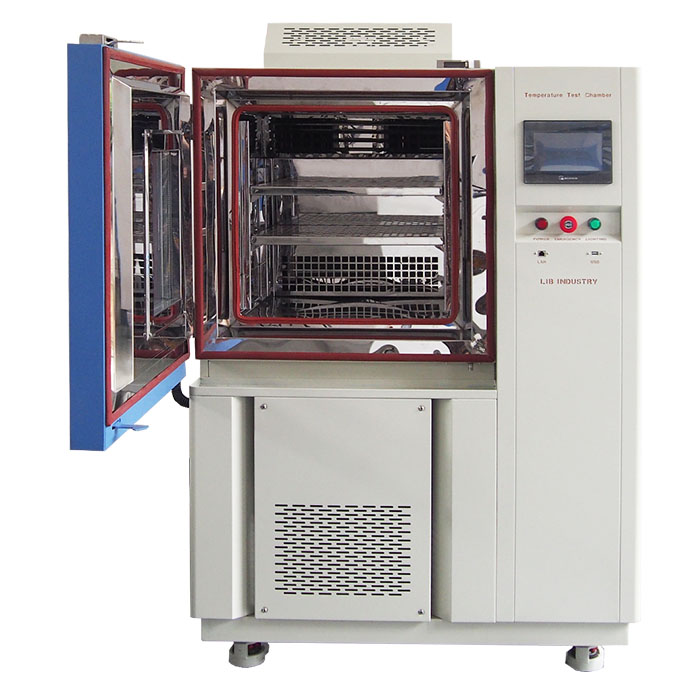 Industrial-grade temperature cycling chambers are designed differently from basic ovens or freezers that may be used for simple cycling tests.
Precision Temperature Control Systems
When combined with PT100 Class A sensors, ceramic-core nichrome heating elements can maintain temperature accuracy within ±0.5°C, even during rapid temperature changes.
This level of control is important when qualifying aerospace, automotive, electronics, and other components under demanding environmental conditions.
A professional temperature cycling chamber can also be equipped with an LCD touch-screen controller and Ethernet or PC connection, allowing engineers to create multi-step test programs and transfer test data for analysis and reporting.
By integrating accurate sensors, stable heating systems, and programmable controls, LIB Industry can configure temperature cycling chambers around specific test requirements rather than relying on a one-size-fits-all setup.
Cascade Refrigeration Technology
Using components from established compressor brands, cascade refrigeration systems can achieve low temperatures down to -70°C, depending on the chamber configuration.
Electronic expansion valve technology allows more precise refrigerant-flow control, helping the refrigeration system respond to significant temperature changes while reducing unnecessary compressor loading. This is particularly useful for chambers subjected to frequent and repeated temperature cycling.
Anti-Condensation and Safety Protection
During testing, built-in anti-condensation control helps keep sample surfaces dry, which can be particularly important for sensitive electronic components during rapid temperature transitions.
The chamber and specimens are also protected by safety systems addressing conditions such as over-temperature, over-current, high pressure, and leakage.
How to Select the Right Chamber Based on Testing Requirements
Matching a chamber to the applicable testing standard can help buyers avoid both unnecessary features and insufficient performance.
| Testing Standard | Typical Ramp Rate | Recommended Chamber Class |
|---|---|---|
| MIL-STD-810 | 5–10°C/min | Standard cascade refrigeration |
| IEC 60068-2-14 | 5–15°C/min | Precision PT100 controlled |
| Automotive AEC-Q100/Q200 | 10–15°C/min | High ramp rate, tight tolerance |
| JEDEC JESD22-A104 | 10–15°C/min | Deep low-temperature cascade system |
These values should be treated as a starting point for chamber selection. The actual chamber configuration should be confirmed against the specific test procedure, sample load, and required temperature range.
Matching Chamber Volume to Sample Batch Size
Larger internal chambers with more space for shelves and fixtures are suitable for buyers testing larger batches or multiple components at the same time.
Smaller benchtop chambers can be more practical for R&D laboratories testing individual components, prototypes, or smaller sample quantities.
The goal is to select enough usable space for the current test program while avoiding excessive chamber capacity that adds unnecessary cost and operating requirements.
Confirming Controller Compatibility
Check whether the controller can connect to existing laboratory software through Ethernet or PC link. Buyers should also confirm that USB data export is compatible with the reporting and documentation format required for their testing program.
A compatible data-logging system can simplify test-data management, reduce manual work, and make it easier to maintain traceable test records.
Reviewing Warranty and Support Terms
Warranty and technical support should be considered alongside chamber specifications.
A 3-Year Manufacturer Warranty / 36 months provides longer equipment coverage, while lifetime free technical support can help customers continue operating and maintaining the chamber after the warranty period.
Buyers should also confirm the manufacturer's spare-parts policy and what happens if a chamber cannot be economically repaired during the warranty period.
LIB Industry provides temperature cycling chambers with factory calibration, technical support, and long-term service coverage.
Temperature Cycling Chamber Applications Across Industries
Different industries use thermal cycling testing for different reasons, but the main objective is to identify potential failures caused by repeated thermal stress.
Aerospace and Defense Component Qualification
Components used at high altitudes or in space can experience repeated exposure to very low and high temperatures. Thermal cycling helps identify potential micro-cracks, seal failures, and other problems associated with differences in the thermal expansion of materials.
Automotive Electronics Reliability Testing
Automotive electronics and battery management systems can experience significant temperature changes during operation. Temperature cycling chambers are therefore used to evaluate solder-joint durability, connector reliability, and other potential thermal-fatigue mechanisms before components enter production vehicles.
Electronics and Semiconductor Manufacturing
Thermal cycling can reveal fatigue in solder joints on printed circuit boards and semiconductor packages. These failures can be difficult to identify through static temperature testing because they are associated with repeated expansion and contraction.
OEM and Supplier Options for Temperature Cycling Chamber Buyers
Buyers requiring non-standard configurations should check whether the manufacturer provides genuine custom engineering rather than only minor modifications to standard catalog models.
A qualified manufacturer should be able to evaluate specific testing requirements, adjust chamber dimensions and performance parameters, and develop solutions for specialized applications. This allows the equipment to be designed around the actual test program instead of forcing complex requirements into a standard configuration.
Standard Versus Custom Chamber Configurations
Most common testing requirements can be covered by standard models across different chamber volumes.
However, buyers with unusual sample dimensions, specialized fixtures, larger workloads, or specific door and window requirements may benefit from customized internal layouts and chamber configurations.
Evaluating Manufacturer Certifications
When a manufacturer has ISO 9001 quality management certification, CE marking, and recognized third-party testing, buyers have additional information for evaluating the manufacturer's quality-management and production processes.
These certifications should be considered together with the manufacturer's technical documentation, factory testing procedures, and actual equipment specifications.
Global Service Network Coverage
Downtime risk can be reduced when a supplier has regional service capabilities and spare-parts support.
LIB Industry supports customers through service centers in Malaysia, Canada, the UK, and the USA, together with remote technical assistance. This provides customers with additional support after installation and during long-term chamber operation.
Requesting a Quote for Temperature Cycling Chambers
To receive an accurate quotation, buyers should provide sufficient technical information instead of requesting a general price without specifying the application.
Information to Prepare Before Contacting Suppliers
When requesting a quote, provide the following information:
- Required temperature range
- Required heating and cooling ramp rate
- Internal chamber volume
- Sample dimensions and quantity
- Fixture or shelf requirements
- Applicable testing standards
- Required data-logging or communication interface
These details have a greater impact on chamber configuration and final pricing than chamber volume alone.
A professional manufacturer can use this information to determine the appropriate refrigeration system, heating capacity, control configuration, internal dimensions, and other customized requirements.
Comparing Quotes Across Multiple Manufacturers
Instead of comparing suppliers only by the final price, ask for detailed quotations that separate the base chamber cost, customization, shipping, installation, calibration, and other services.
This makes it easier to compare what is actually included in each quotation and reduces the risk of unexpected costs later.
Timeline Expectations From Quote to Delivery
Standard configurations generally require less engineering time than custom-engineered chambers.
Before placing an order, buyers should confirm the manufacturing lead time, shipping schedule, installation requirements, and commissioning plan so the equipment can be integrated into the overall project schedule.
FAQ
What ramp rate should I look for in a temperature cycling chamber?
Ramp rate depends on the applicable testing standard. Many industrial applications require approximately 5°C to 15°C per minute for heating and cooling, while electronics and automotive component fatigue testing may require higher ramp rates.
How deep should the low-temperature range go for aerospace testing?
Aerospace and defense applications may require chambers reaching -70°C or lower, depending on the test procedure. Cascade refrigeration systems are commonly used when stable operation is required at extreme low temperatures.
What warranty length is standard for industrial temperature cycling chambers?
Warranty terms vary by manufacturer and configuration. LIB Industry provides a 3-Year Manufacturer Warranty / 36 months, together with lifetime free technical support. Buyers should also confirm the manufacturer's repair and replacement policy before purchase.
Related Temperature Cycling and Environmental Test Chambers
|
|
|
|
| High and Low Temperature Test Chamber Designed for high- and low-temperature exposure and cycling when humidity control is not required. It is suitable for components, materials, and products requiring controlled temperature stress testing. |
Temperature & Humidity Test Chamber Adds controlled humidity to temperature testing for applications where combined temperature and moisture conditions are required. |
Thermal Shock Test Chamber Designed for rapid transitions between different temperature zones when the test program requires a more severe thermal shock condition than conventional cycling. |


Conclusion
If you want to buy a temperature cycling chamber, the lowest initial price should not be the only consideration. The chamber should be evaluated against the actual testing standard and requirements, including ramp rate, internal volume, temperature accuracy, refrigeration technology, controller compatibility, warranty, and technical support.
A reliable manufacturer should provide clear technical specifications and help buyers determine whether the chamber configuration is appropriate for the intended application. Providing complete technical requirements before requesting a quotation also allows the manufacturer to prepare more accurate pricing, configuration, and delivery information.
LIB Industry provides temperature cycling chambers for aerospace, automotive, electronics, semiconductor, and other reliability-testing applications, with customized configurations available for specific testing requirements.
For a quotation, send your temperature range, ramp rate, sample dimensions, chamber volume, and applicable test standard to ellen@lib-industry.com.


