How Much Do Benchtop Test Chambers Cost for R&D Labs?
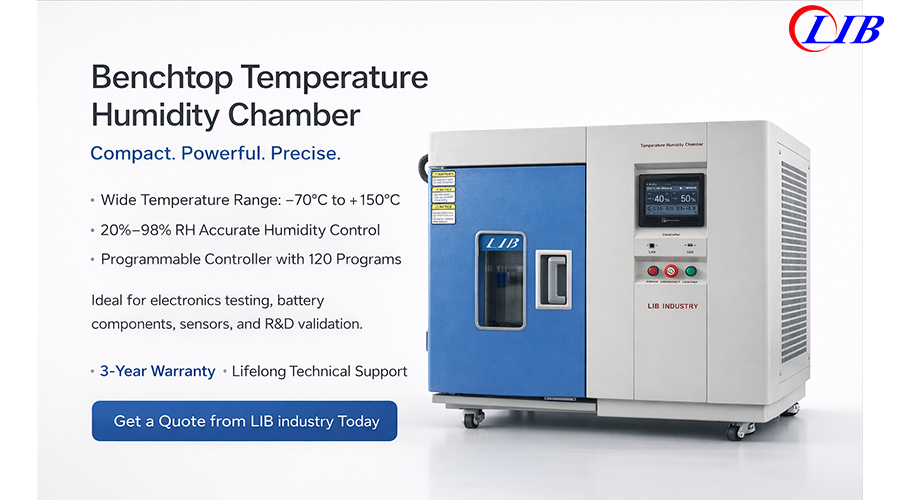
Benchtop test chambers provide temperature and humidity control for R&D laboratories that need reliable environmental testing without a large floor-standing unit. The benchtop test chamber cost depends on chamber volume, temperature range, humidity control, safety features, and customization.
For example, a 50L chamber with a minimum temperature of -20°C will generally cost less than an 80L model reaching -70°C. To compare quotations accurately, laboratories should consider not only the initial purchase price but also installation, training, energy consumption, and after-sales support.
Need a benchtop test chamber for your R&D testing requirements? Request a quote in 24 hours.
What Factors Determine Benchtop Test Chamber Prices?
Several specifications influence the final quotation.
| Cost Factor | What Affects the Price |
|---|---|
| Chamber volume | 50L or 80L capacity |
| Temperature range | -20°C, -40°C, or -70°C minimum temperature |
| Humidity control | Humidity range, humidification system, and sensors |
| Controller and connectivity | Touchscreen, data logging, Ethernet, and remote monitoring |
| Safety and customization | Battery protection and special configurations |

Why Do Benchtop Chamber Quotations Differ?
Two chambers with the same volume may have different prices because of their refrigeration systems, sensors, controllers, and safety features. For example, a -70°C model typically requires a more complex refrigeration system than a -20°C model.
LIB industry benchtop chambers are designed for compact laboratory use while providing controlled temperature and humidity conditions. Compare the complete specifications rather than selecting a chamber based on price alone.
How Do Chamber Size and Temperature Range Affect Cost?
Chamber Volume
LIB industry offers compact temperature and humidity chambers in 50L and 80L configurations.
| Model | Internal Size (mm) | External Size (mm) | Volume |
|---|---|---|---|
| TH-50 | 320 × 350 × 450 | 820 × 1160 × 950 | 50L |
| TH-80 | 400 × 400 × 500 | 900 × 1210 × 1000 | 80L |

The right size depends on sample dimensions, quantity, and the space needed for airflow.
Temperature Range and Performance
LIB industry offers three temperature classes:
Class A: -20°C to +150°C
Class B: -40°C to +150°C
Class C: -70°C to +150°C
Lower temperature requirements generally increase equipment cost because they require more demanding refrigeration systems.
The standard heating and cooling rates are also important. LIB specifications list heating at 3°C/min and cooling at 1°C/min. Confirm the required ramp rate under your actual sample load before ordering.
How Do Testing Requirements Affect Chamber Configuration?
Humidity and Application Requirements
For temperature and humidity testing, confirm the required relative humidity range, temperature-humidity profile, and dwell times. LIB industry chambers support humidity control, but the exact operating range should be verified against your test protocol, especially when low-humidity conditions are required.
These chambers can support R&D applications involving electronics, materials, automotive components, food packaging, and product aging studies.
Safety and Special Samples
If you are testing batteries or other sensitive samples, specify any additional safety requirements before requesting a quotation. Special protection features and customized configurations may increase the total cost.
Standard vs. Custom Benchtop Test Chambers
Standard models are generally more straightforward to configure and quote, while custom designs may require additional engineering and lead time.
Standard Features
Depending on the selected configuration, LIB industry chambers can include:
SUS304 stainless steel interior
Polyurethane foam insulation
Two shelves
A cable port with a plug
An observation window and interior lighting
A 7-inch touchscreen controller
Additional cable ports, including 100mm and 200mm options, may be available. Confirm the final configuration with the supplier.
When Is Customization Necessary?
Customization may be appropriate when standard chambers cannot accommodate your sample dimensions, cable connections, monitoring equipment, or specific test procedure. Confirm these requirements early to avoid unnecessary engineering costs and delays.
What Is Included in the Total Chamber Cost?
The equipment quotation may not cover every expense associated with purchasing and operating a chamber.
Delivery and installation: Check shipping costs, customs charges, and installation requirements.
Training and commissioning: Confirm whether setup assistance and operator training are included.
Operating costs: Consider electricity, water for humidification, and routine maintenance.
Calibration and documentation: Verify whether the required calibration records and test documentation are supplied.
A complete quotation makes it easier to compare suppliers and estimate the total cost of ownership.
How to Evaluate Value Beyond the Purchase Price
 A lower initial price does not necessarily mean better long-term value. Temperature and humidity accuracy, repeatability, connectivity, and after-sales support all affect laboratory operation.
LIB industry provides benchtop chambers with temperature and humidity control, data communication options, and configurations for different R&D requirements. The company also states that its products are supported by ISO 9001 quality management, CE certification, and SGS and TÜV verification.
Its service package includes a 3-year warranty, lifetime service support, and 24/7 technical assistance. Installation, training, and other services should be confirmed in the quotation.
LIB industry provides benchtop test chambers for laboratory temperature and humidity testing.
Benchtop Test Chamber Buying Tips for R&D Labs
Before requesting quotations, prepare a brief covering:
- Sample dimensions, weight, and quantity
- Required temperature and humidity ranges
- Heating and cooling rates and dwell times
- Applicable test standards
- Data logging, cable ports, and safety options
- Delivery, installation, training, and warranty requirements
Send the same requirements to each supplier so you can compare equivalent configurations. If your laboratory expects to expand its testing program, consider future sample sizes and test requirements before choosing a model.
Request a Benchtop Test Chamber Quote from LIB Industry
Choosing the right benchtop test chamber means balancing capacity, temperature and humidity performance, safety, and total ownership costs.
LIB industry provides environmental testing equipment and one-stop testing solutions, including equipment customization, installation, and training. With a 3-year warranty and lifetime service support, LIB industry helps laboratories plan for long-term testing needs.
Contact inquiry@libtestchamber.com with your sample details and test requirements to request a suitable configuration and quotation.
Related Testing Equipment
|
|
|
|
|
Temperature and Humidity Test Chamber Suitable for testing products and materials under controlled temperature and humidity conditions. It is relevant to R&D laboratories that need more flexible environmental testing configurations. |
Thermal Cycling Chamber Designed for repeated temperature changes to evaluate product reliability under thermal stress. It is useful when testing requirements focus on temperature cycling rather than humidity. |
Accelerated Weathering Tester Used to evaluate material durability under UV exposure and moisture conditions. It complements benchtop environmental testing when R&D projects include weathering resistance. |


FAQ
What affects benchtop test chamber cost the most?
The minimum temperature, chamber volume, humidity requirements, and additional safety or customization options are major cost factors.
Is a benchtop test chamber as accurate as a floor-standing model?
Performance depends on the selected model and configuration. Compare temperature and humidity control accuracy, uniformity, and repeatability data to determine whether a chamber meets your testing requirements.
What information should I provide for a quotation?
Provide sample dimensions and quantity, temperature and humidity ranges, ramp rates, dwell times, test standards, safety requirements, and any installation or training needs.