How to Choose an Accelerated Weathering Tester Manufacturer?
Finding the right accelerated weathering tester manufacturer is just as important as selecting the equipment itself. Chamber quality, standards compliance, test stability, and after-sales support all affect the reliability of long-term material testing.
For buyers looking to buy accelerated weathering testers, the equipment should be able to reproduce controlled UV radiation, temperature, and moisture cycles according to requirements such as ASTM G155 and ISO 4892. The manufacturer's engineering experience and ability to support calibration, spare parts, and technical service are also important factors to consider.
This guide explains what to look for in an accelerated weathering tester, which specifications deserve attention, and how global buyers can evaluate manufacturers before purchasing.
What Is an Accelerated Weathering Tester and How Does It Work?
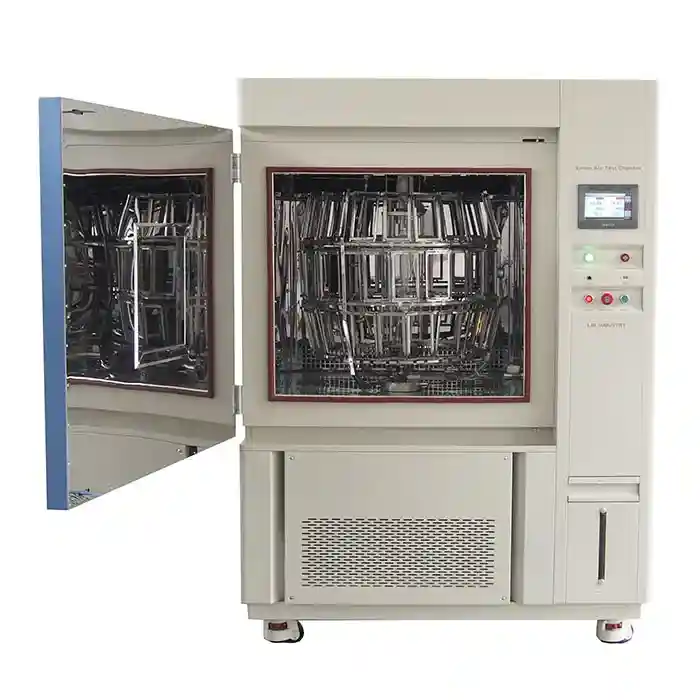
Reproducing Outdoor Exposure in a Controlled Chamber
An accelerated weathering tester exposes paints, plastics, polymers, and other materials to controlled cycles of UV or simulated sunlight, temperature, and moisture. The purpose is to accelerate weathering effects that materials may experience during outdoor exposure.
Xenon arc lamps can simulate a broad portion of the solar spectrum, making xenon-based systems suitable for applications where fading, discoloration, surface degradation, and other outdoor weathering effects need to be evaluated.
Why Does Rotating Specimen Exposure Matter?
A rotating specimen rack moves samples around the light source to help provide more uniform exposure. This is particularly useful when multiple specimens are tested at the same time.
Uniform specimen positioning and controlled exposure help reduce variations caused by differences in distance from the lamp, improving the consistency of test results.
Standards Compliance Defines Test Validity
Standards such as ASTM G155 and ISO 4892 specify requirements for xenon arc weathering tests, including exposure conditions and measurement methods.
For buyers, it is therefore important to confirm not only that a chamber is described as “ASTM” or “ISO” compliant, but also that its configuration and control system support the specific test procedure required for the application.
Key Specifications to Evaluate Before Choosing a Manufacturer
When comparing accelerated weathering tester manufacturers, buyers should evaluate the equipment against their actual testing requirements rather than focusing only on the purchase price.
| Specification | Why It Matters | Typical Range |
|---|---|---|
| Light source power | Determines available irradiance and test capability | 4500W xenon arc |
| Lamp lifespan | Affects replacement and operating costs | About 1,600 hours |
| Black panel temperature | Controls specimen surface temperature during exposure | 35–85°C |
| Humidity control | Supports condensation and moisture exposure cycles | 30–98% RH |
| Sample capacity | Determines testing throughput | Up to 42 specimens |
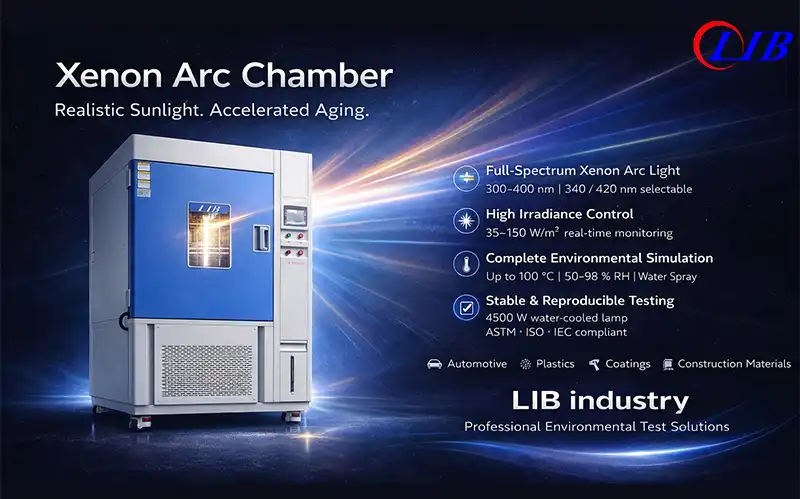
Irradiance Control and Spectral Range
A weathering tester should provide stable and controllable irradiance appropriate for the selected test method. LIB Industry's xenon arc system uses interchangeable filters for different exposure requirements, with a stated wavelength range of 280–800 nm.
When comparing manufacturers, buyers should look beyond lamp power and confirm how irradiance is monitored, controlled, and maintained throughout long exposure cycles.
Black Panel Temperature Accuracy
Black panel temperature represents the temperature reached by a dark test surface under simulated sunlight and is an important parameter in accelerated weathering tests.
For LIB Industry's xenon arc weathering system, the black panel temperature range is 35–85°C, with a stated accuracy of ±2°C. Buyers should confirm the required temperature range and control accuracy against their applicable test method.
Data Logging and Remote Monitoring
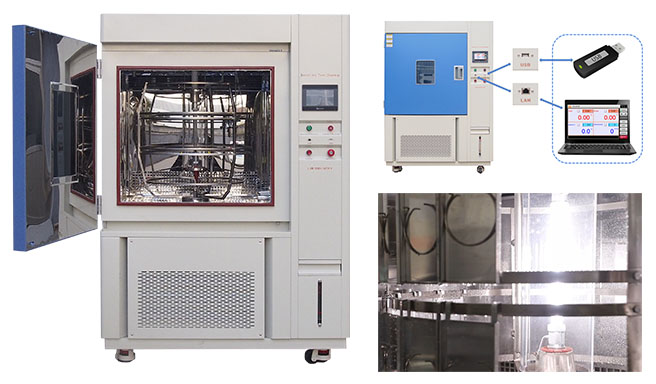
Real-time monitoring and data recording can simplify long-duration testing and provide useful records for quality control. Depending on the configuration, features such as programmable control and Ethernet or Wi-Fi connectivity can support remote monitoring and data management.
For tests lasting hundreds or thousands of hours, reliable data records are particularly useful when reviewing test conditions or comparing results between batches.
Water Management and Filtration Design
Water is an important part of many weathering cycles, including spray and condensation exposure. A closed-loop water circulation system with filtration can help reduce mineral buildup and protect the water system during long-term operation.
When evaluating a manufacturer, buyers should therefore consider not only initial equipment cost but also water consumption, filtration, maintenance requirements, and replacement parts.
Why Choose a Professional Accelerated Weathering Tester Manufacturer?
Engineering Experience Supports Long-Term Operation
Xenon arc weathering equipment combines a high-power light source with temperature and water-control systems. Long-term operation therefore places continuous demands on the lamp, cooling, circulation, and control systems.
A manufacturer with dedicated weathering equipment experience can provide a configuration that is better matched to these requirements, from lamp selection and filters to specimen exposure and temperature control.
Certification and Compliance Support
Manufacturers familiar with ASTM G155 and ISO 4892 can configure exposure conditions according to the applicable testing requirements. This helps laboratories avoid purchasing equipment that has suitable hardware but lacks the control functions needed for their specific test program.
Before purchasing, buyers should confirm the applicable standard, irradiance requirement, filter configuration, black panel temperature, humidity or water exposure, and required test duration.
Responsive Global After-Sales Support
Xenon lamps and other consumable components require periodic replacement. Buyers should therefore check whether the manufacturer can provide spare parts, technical support, calibration assistance, and troubleshooting after installation.
For international laboratories, local or regional service coverage can also help reduce downtime when maintenance is required.
How to Evaluate Accelerated Weathering Tester Suppliers Worldwide?
Requesting Third-Party Quality Certifications
Quality certifications and third-party verification can provide additional information when comparing manufacturers. Buyers can check documentation such as ISO 9001, CE, and available third-party inspection or testing records from organizations such as SGS or TÜV.
The exact documents required should depend on the buyer's market, internal quality system, and project requirements.
Reviewing Manufacturing Track Record and Global Reach
A manufacturer's production experience, installed equipment, and international service network can help buyers understand its ability to support long-term projects.
LIB Industry was founded in 2009 and provides environmental simulation equipment for customers in more than 60 countries. Its service network includes locations in Malaysia, Canada, the UK, and the USA.
Confirming Customization and Lamp Technology Options
Weathering requirements vary by material and application. UV fluorescent systems may be appropriate for certain UV aging programs, while xenon arc systems are used when a broader simulated solar spectrum is required.
Before ordering, buyers should confirm the lamp type, filter configuration, irradiance range, specimen capacity, temperature and humidity requirements, and exposure method with the manufacturer.
Accelerated Weathering Tester Solutions for Different Industries
Testing requirements vary according to the material and final application.
Automotive: Weathering testers can be used to evaluate exterior coatings, plastics, trim components, and other materials for fading, discoloration, gloss loss, and surface degradation.
Construction and building materials: Coatings, sealants, composite materials, and other products can be exposed to controlled UV, temperature, and moisture cycles to evaluate weathering resistance.
Electronics and consumer products: Weathering testing can help evaluate outdoor materials, housings, surface finishes, and components that may experience sunlight and moisture during service.
Matching the tester's configuration to the actual material and test method is more important than simply selecting a chamber based on its general capacity.
LIB Industry Accelerated Weathering Tester Solutions
LIB Industry's XL-S-750 Xenon Arc Weathering Chamber is designed for accelerated weathering applications requiring controlled xenon arc exposure.
The system uses a 4500W water-cooled xenon arc lamp with an expected lamp life of approximately 1,600 hours. Interchangeable filters can be selected according to different exposure requirements, covering a stated wavelength range of 280–800 nm.
A rotating specimen rack accommodates up to 42 specimens, helping provide consistent exposure around the lamp. The black panel temperature can be controlled from 35–85°C with a stated accuracy of ±2°C, while the chamber supports controlled humidity and water exposure.
The water circulation system includes multi-stage filtration, and Ethernet or Wi-Fi connectivity can support remote monitoring and data recording depending on configuration.
For international buyers, LIB Industry also provides:
3-Year Manufacturer Warranty / 36 months
Lifetime free technical support
Traceable factory calibration, with an ISO 17025-related calibration report where applicable
24/7 remote video assistance
48-Hour Spare Parts Express via DHL/FedEx
LIB Industry provides xenon arc weathering chambers configured for ASTM G155, ISO 4892, and related weathering requirements.
Related Environmental Testing Products
|
|
|
|
| UV Accelerated Weathering Tester Suitable for accelerated UV aging programs using fluorescent UV lamps, particularly for applications focused on UV-induced surface degradation. |
Temperature & Humidity Test Chamber Provides controlled temperature and humidity conditioning for materials and components before or after weathering exposure. |
Salt Spray Test Chamber Designed for corrosion resistance testing of coatings, metals, and components where salt exposure is part of the required evaluation. |


How to Choose the Right Accelerated Weathering Tester Manufacturer?
Before purchasing, confirm four areas: the required testing standard, the chamber's actual control specifications, the manufacturer's technical experience, and long-term service capability.
If you are looking to buy an accelerated weathering tester, send LIB Industry your required standard, material type, specimen dimensions, exposure conditions, and expected test capacity. We can recommend a suitable configuration for your application.
Request a quote: ellen@lib-industry.com
FAQ
What standards should an accelerated weathering tester support?
Common standards include ASTM G155 and ISO 4892. The exact chamber configuration should be selected according to the specific test method, irradiance requirement, filter type, temperature, humidity, and exposure cycle.
How long does a xenon arc lamp usually last?
LIB Industry's xenon arc system uses a lamp with an expected service life of approximately 1,600 hours. Actual replacement requirements depend on operating conditions and the required irradiance performance.
What does sample capacity have to do with choosing a manufacturer?
Sample capacity affects testing throughput. A chamber that accommodates up to 42 specimens can support larger batches and reduce the number of separate test runs required for similar materials.
What should I provide when requesting an accelerated weathering tester quotation?
Provide the applicable standard, material or product type, specimen dimensions, number of specimens, required exposure conditions, and expected testing capacity. These details allow the manufacturer to recommend a chamber configuration rather than quoting a generic model.