What Is a Thermal Shock Test Chamber, and How Do You Pick the Right Manufacturer?
Choosing a thermal shock test chamber manufacturer is a decision that affects a lab's approval results for years, not just one purchase order. This guide answers the question directly, walks through the technical standards behind thermal shock testing, compares chamber types side by side, and shows how LIB Industry's thermal shock chambers — and the customers already using them — hold up under real qualification programs. By the end, engineers and procurement teams will know exactly which specifications to check, which certifications to ask for, and which questions to put to any thermal shock chamber manufacturer before signing a contract.
What Is a Thermal Shock Test Chamber?
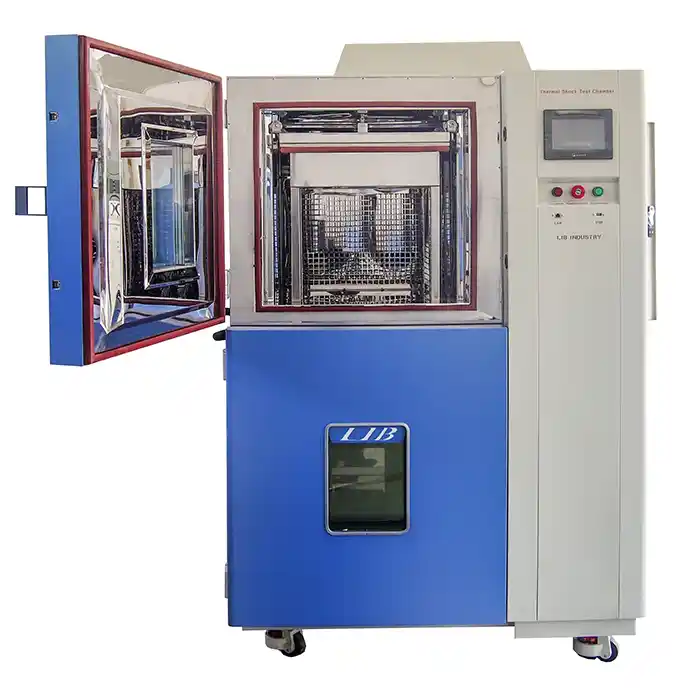
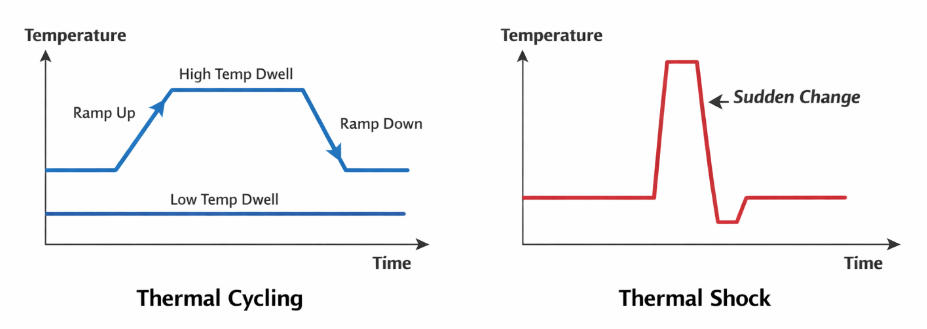
 A thermal shock test chamber is built with two separate zones — one hot, one cold — and a mechanical basket that shuttles specimens between them. Unlike thermal cycling chambers, which ramp temperature up and down gradually inside a single compartment, a thermal shock chamber forces an almost instantaneous swing by physically relocating the sample. That abrupt change compresses years of field temperature stress into a matter of days, exposing solder joint fatigue, delamination, and encapsulant cracking that slower testing methods can miss entirely.
Thermal shock vs. thermal cycling, in short:
Thermal cycling controls the rate of temperature change over several minutes.
Thermal shock skips the ramp — transfer between zones typically finishes in under a minute, sometimes under 30 seconds — producing a much higher strain rate on the material.
Which Specifications Actually Matter When Selecting a Chamber?
Not every published spec sheet number translates into better test data. The four that matter most are temperature range, recovery time, interior volume, and loading capacity.
| Specification | Why It Matters | Typical Range |
|---|---|---|
| Temperature range | Sets which qualification standards the chamber can support | -75°C to +220°C |
| Recovery time | Faster recovery keeps the shock severe and repeatable | Under 5 minutes |
| Interior volume | Needs to match specimen size and batch size | 22L to 500L+ |
| Loading capacity | Overloading distorts airflow and temperature uniformity | 20kg to 60kg+ |
| Temperature uniformity | Tighter tolerance means more comparable results run to run | ±0.5°C fluctuation |
Temperature range should exceed the strictest standard a lab plans to run — some protocols call for extremes as wide as -65°C to +150°C, and margin above that ceiling avoids limiting future test programs.
Recovery time — how fast the chamber returns to setpoint after each basket transfer — directly determines whether a test cycle actually meets a standard's transition requirement. A chamber that recovers within five minutes keeps cycle counts predictable and results repeatable.
Interior volume and loading capacity need to be checked against real specimen plans, not just individual part dimensions. A chamber sized for a single component may be too small once assembled modules or full batch quantities are loaded in.
Air-to-Air vs. Liquid-to-Liquid Thermal Shock Chambers: Which One Fits Your Program?
| Factor | Air-to-Air Chamber | Liquid-to-Liquid Chamber |
|---|---|---|
| Typical transfer medium | Conditioned air | Fluorinert or similar liquid bath |
| Transfer speed | Seconds to under 1 minute | Near-instant, sub-second |
| Best suited for | PCBs, ICs, connectors, general electronics | Hermetically sealed components, extreme strain testing |
| Relative cost | Lower | Higher |
| Common standards | MIL-STD-883 Method 1010, JEDEC JESD22-A106 | Specialized aerospace/defense protocols |
|
|
|


Most electronics and automotive qualification labs run air-to-air chambers because the standards they follow — MIL-STD-883 Method 1010, JEDEC JESD22-A106, and IEC 60068-2-14 — are written around that transfer method. Liquid-to-liquid systems are reserved for programs that need the fastest possible strain rate on sealed or hermetic packages.
Why the Manufacturer Behind the Chamber Matters as Much as the Spec Sheet
Engineering depth. Repeated extreme cycling puts sustained mechanical and thermal load on the refrigeration system. Manufacturers with deep engineering experience design components that survive years of that stress instead of failing early.
Certification and compliance support. A manufacturer familiar with MIL-STD-883 Method 1010, JEDEC JESD22-A106, and IEC 60068-2-14 can pre-load controller profiles matched to those protocols, cutting down setup and validation time considerably.
After-sales response. A chamber that sits idle waiting for a replacement part stalls an entire qualification schedule. Manufacturers who keep spare parts on hand and respond quickly to service requests keep testing programs on track.
How to vet a manufacturer before buying:
Ask how long the company has specifically built thermal shock (not just standard environmental) chambers — rapid-transfer engineering is a different discipline.
Request ISO 9001, CE, and independent third-party test validation documents.
Confirm the company can support custom basket sizes, non-standard chamber dimensions, and specialized control requirements.
Ask which compressor brand and refrigerant the chamber uses — established components generally outlast generic ones under constant hot-cold cycling.
LIB Industry's Thermal Shock Chamber Lineup
LIB Industry builds thermal shock test chambers, including air-to-air thermal shock chambers, with interior volumes from 22L to 505L and loading capacity up to 60kg. Chambers cover a temperature range of -75°C to +220°C and recover to setpoint within five minutes of each basket transfer.
Construction uses French TECUMSEH compressors, an environmentally friendly refrigerant, and a stainless-steel interior chosen to withstand sustained, repeated shock cycling without premature wear. Touchscreen controllers with Ethernet connectivity are built for programming and tracking longer qualification runs.
LIB Industry's service covers the full lifecycle of a chamber purchase — design consultation, manufacturing, commissioning, delivery, installation, and operator training — through a single point of contact.
Popular LIB Thermal Shock Chamber Models
Compact Air-to-Air Thermal Shock Chamber (22L–64L): suited for component-level and small-batch semiconductor qualification.
Mid-Volume Thermal Shock Chamber (150L–225L): a common choice for automotive electronics testing under AEC-Q100.
Large-Capacity Thermal Shock Chamber (300L–505L): built for assembled modules and higher-volume batch testing.
Where Thermal Shock Testing Is Required
Aerospace and defense electronics. Military and aircraft microcircuits are routinely qualified to MIL-STD-883 Method 1010 because mission-critical parts can't be allowed to fail under sudden altitude or temperature swings.
Automotive electronics. Engine bay and transmission sensors face some of the harshest thermal environments in any consumer product; AEC-Q100 certification, now standard for automotive ICs and passive components, requires thermal shock testing to prove reliability.
Consumer electronics and semiconductor packaging. The JEDEC JESD22-A106 test checks plastic-encased semiconductor packages for die-attach and wire-bond reliability, catching packaging defects before products reach the market.
Customer Feedback
Labs running ongoing qualification programs have pointed to two things most often when describing their experience with LIB Industry: how quickly a chamber was commissioned and brought online after delivery, and how responsive the technical support team has been when questions come up mid-program. On-site installation and operator training are typically completed together, so testing staff can start running qualification cycles without a separate learning curve.
Frequently Asked Questions
What temperature range should a thermal shock chamber cover for electronics testing? Most qualification protocols run between -65°C and +150°C. LIB Industry chambers cover -75°C to +220°C, comfortably supporting MIL-STD-883, JEDEC JESD22-A106, and IEC 60068-2-14.
How is thermal shock testing different from thermal cycling testing? Thermal shock relies on rapid basket transfer, usually under a minute, producing a higher strain rate. Thermal cycling controls a gradual temperature ramp over several minutes and tests different failure mechanisms.
Why does basket transfer speed affect test validity? Standards that specify fast changeover times assume the chamber can actually move specimens between zones that quickly. A slower transfer softens the thermal strain, which can understate a product's real-world failure risk.
How often should the refrigeration system be serviced? Because thermal shock chambers cycle far more aggressively than standard environmental chambers, manufacturers generally recommend more frequent preventive maintenance checks on compressors and seals — ask the manufacturer for their specific service interval.
Can a thermal shock chamber be customized for non-standard specimen sizes? Yes. Manufacturers with in-house engineering teams, including LIB Industry, can build custom basket configurations and chamber dimensions around specific qualification programs rather than limiting buyers to stock sizes.
What warranty and after-sales support come with a LIB Industry thermal shock chamber? LIB Industry chambers include a 3-year warranty plus lifetime after-sales service, covering technical support, spare parts, and ongoing maintenance guidance for the life of the equipment.
|
|
|
|
|
thermal cycling test chamber |
Water Immersion Tank |
|
|
|
|
|
|
Dust Test Chamber |
Blowing Rain Test Chamber |
ozone test machine |


Get a Thermal Shock Chamber Recommendation
The right thermal shock test chamber comes down to matching temperature range, recovery time, and volume to the actual qualification standard being run — backed by a manufacturer with genuine engineering depth and after-sales support. Chambers that meet MIL-STD-883, JEDEC JESD22-A106, and IEC 60068-2-14 give buyers confidence their approval data will hold up under scrutiny.
Looking for a thermal shock test chamber manufacturer, supplier, or partner for a qualification testing program? Email ellen@lib-industry.com to talk with LIB Industry about environmental testing solutions built around your program's requirements.