How Do Dust Test Chambers Improve Automotive Component Reliability?
Automotive electronics, sensors, connectors, and engine components are regularly exposed to dust from roads, construction sites, and dry environments. Dust test chambers simulate these conditions under controlled dust concentration and circulation to evaluate whether components can maintain their required ingress protection.
Vehicles may operate on dusty construction sites, unpaved roads, and dry desert routes. Components therefore need to demonstrate protection against fine particles that can enter through gaps, joints, and connectors. Standards such as IEC 60529 and ISO 20653 are used to evaluate dust protection for automotive components, including IP5X, IP6X, IP5KX, and IP6KX ratings.
Why Is Dust Testing Important for Automotive Components?
Automotive parts can experience continuous dust exposure combined with road vibration, airflow, and engine-bay heat.
When dust enters sensitive components, it can cause electrical faults, contact corrosion, or mechanical wear. For sensors and control modules involved in vehicle operation, poor sealing can create reliability and safety concerns.
For automotive suppliers, dust testing also provides documented evidence for product validation, supplier qualification, and warranty-risk reduction. Testing during development allows engineers to identify sealing problems before they become expensive production or field failures.
Which Automotive Components Need Dust Testing?
Different automotive components face different levels of dust exposure.
Engine Control Units and Sensors
Control modules, oxygen sensors, mass airflow sensors, and other engine-bay electronics can be exposed to heat and airborne particles. Dust testing helps verify whether their housings and connectors provide adequate protection.
Electrical Connectors and Wiring Harnesses
Connector housings need reliable seals to prevent particle ingress. Dust entering a connection can lead to intermittent electrical problems that are difficult to diagnose after the vehicle enters service.
Undercarriage and Suspension Electronics
Wheel-speed sensors, suspension sensors, and other undercarriage electronics are exposed to road dust and debris. These components may require higher levels of ingress protection because of their location close to the road surface.
How Does a Dust Test Chamber Simulate Automotive Conditions?
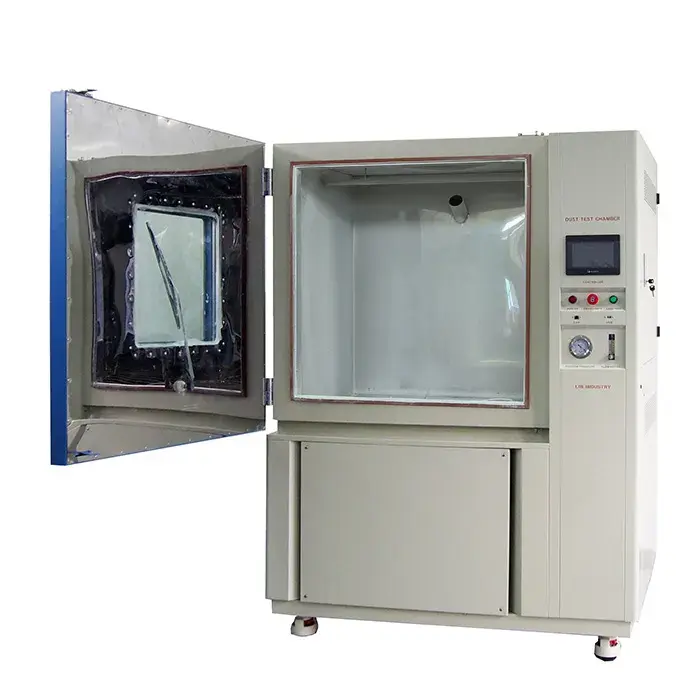
.webp "blog-1-1") A dust test chamber provides controlled and repeatable exposure that is difficult to achieve in outdoor testing.
A dust test chamber provides controlled and repeatable exposure that is difficult to achieve in outdoor testing.
Controlled Dust Concentration and Circulation
Fine particles such as talcum powder are circulated through the test space at controlled levels. This creates a consistent dust environment around the specimen and allows engineers to repeat the test under comparable conditions.
Vacuum-Assisted Ingress Testing
For applicable tests, a vacuum interface can create a pressure difference across the specimen. Air and dust can then be drawn toward potential leakage points, helping reveal weaknesses in seals, gaps, and openings that passive dust exposure may not identify as effectively.
Temperature-Controlled Dust Testing
Some automotive applications require dust exposure under elevated temperatures. Programmable temperature control up to 80°C can simulate conditions experienced by components operating near the engine bay.
Need to test automotive components for IP5X, IP6X, IP5KX, or IP6KX? Contact LIB Industry with your specimen dimensions and applicable standard for a suitable configuration.
Which Standards Apply to Automotive Dust Testing?
| Standard | Classification | Typical Application |
|---|---|---|
| IEC 60529 | IP5X / IP6X | General electrical enclosure dust protection |
| ISO 20653 | IP5KX / IP6KX | Road vehicle-specific ingress protection |
| MIL-STD-810 | Method 510 | Military and ruggedized electronics |
IEC 60529 provides general IP enclosure protection classifications, while ISO 20653 is specifically related to road vehicles and their electrical and electronic equipment.
For supplier qualification and product validation, manufacturers should also maintain test records showing dust exposure conditions, test duration, specimen condition, and post-test inspection results.
How Do You Choose the Right Dust Test Chamber?
The chamber should match both the specimen size and the applicable test method.
Matching Chamber Volume to Component Size
Small connectors and sensors do not require the same chamber capacity as larger control modules or undercarriage components. Chambers in the 800–2000 L range can accommodate a variety of automotive specimens while providing practical testing space.
Evaluating Powder Management
A funnel-shaped chamber bottom and heated powder recovery system can help prevent moisture-related clumping and improve dust distribution consistency. Reliable powder management is important when repeated tests need comparable conditions.
Confirming Safety and Control Features
Features such as electromagnetic door locks, emergency stops, Ethernet connectivity, monitoring, and data logging improve operational safety and make long-duration testing easier to manage.
LIB Industry Dust Test Chambers for Automotive Testing
LIB Industry provides dust test chambers for automotive electronics, sensors, connectors, control modules, and other components requiring IP5X, IP6X, IP5KX, or IP6KX testing. The chambers use a funnel-shaped bottom, electric heating, and dust circulation system to support stable powder distribution during repeated tests.
The system can provide programmable temperature control up to 80°C, vacuum-assisted testing, electromagnetic door locks, emergency stops, and Ethernet-connected control and data logging. Chamber size, specimen fixtures, dust concentration, and temperature configuration can be customized according to the required standard and specimen dimensions.
LIB Industry also provides turn-key testing solutions, including chamber design, production, installation, commissioning, and operator training. Each system is manufactured under an ISO 9001 quality management system and supplied with CE certification and third-party inspection, backed by a 3-year warranty and lifetime service support.
Related Environmental Test Chambers
Automotive component validation may require several environmental tests in addition to dust ingress testing:
|
|
|
|
| Water Spray Test Chamber – evaluates resistance to water ingress for automotive housings and connectors. | Temperature & Humidity Chamber – evaluates component reliability under controlled temperature and humidity conditions. | Salt Spray Test Chamber – tests the corrosion resistance of automotive metals, coatings, and components. |


FAQ
What IP ratings are commonly tested for automotive components?
Common dust protection ratings include IP5X and IP6X under IEC 60529, as well as IP5KX and IP6KX under ISO 20653 for road vehicle applications.
Why is vacuum assistance used in dust testing?
Vacuum assistance creates a pressure difference that can draw air and dust toward potential leakage points, helping engineers identify weaknesses in seals and housing openings.
Can automotive dust testing be performed at elevated temperatures?
Yes. Where required by the test method, a dust test chamber can integrate temperature control. LIB Industry systems can provide temperature control up to 80°C for applications requiring combined heat and dust exposure.
Looking for a Dust Test Chamber for automotive component validation? Contact LIB Industry with your specimen size, required IP rating, and applicable standard to discuss a suitable testing solution.