What Affects Temperature Cycling Chamber Manufacturing Costs?
The cost of a temperature cycling chamber can vary significantly depending on temperature range, chamber volume, ramp rate, refrigeration system, materials, and customization requirements.
A small 100L chamber designed for moderate temperature cycling is very different from a large chamber requiring -70°C operation and a 15°C/min ramp rate.
For buyers, the important question is not simply “How much does a temperature cycling chamber cost?” but:
What specifications do I actually need, and which factors are worth paying more for?
This guide explains the main cost drivers and shows how LIB Industry can help you select a suitable temperature cycling chamber without over-specifying your equipment.
Need a temperature cycling chamber for your required test standard? Request a quote in 24 hours.
Request a Quote → ellen@lib-industry.com
What Determines the Cost of a Temperature Cycling Chamber?
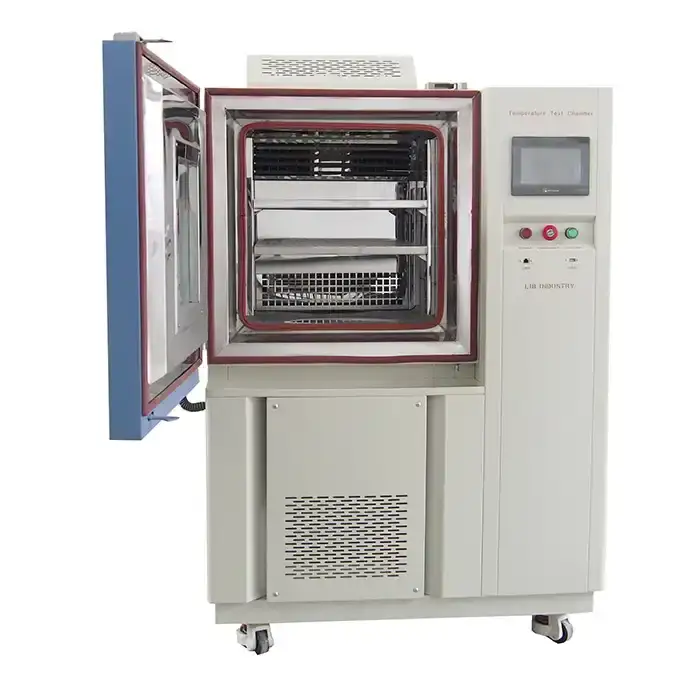
Several technical factors directly affect the manufacturing cost of a temperature cycling chamber.
The most important are:
- Temperature range
- Temperature change rate
- Internal chamber volume
- Refrigeration technology
- Heating capacity
- Chamber materials and insulation
- Control system
- Safety configuration
- Customization requirements
Among these factors, temperature range and ramp rate usually have the greatest impact on the refrigeration and heating systems.
1. How Does Temperature Range Affect Chamber Cost?
The deeper the chamber needs to operate below zero, the more demanding the refrigeration system becomes.
A chamber designed for -20°C can generally use a simpler refrigeration configuration. Reaching -40°C requires greater cooling capacity, while applications requiring -60°C or -70°C may require cascade refrigeration.
This means that specifying a lower minimum temperature than your actual test requires can unnecessarily increase the equipment cost.
For example, LIB Industry's temperature cycling chamber solutions can be configured for different low-temperature requirements rather than using the same refrigeration system for every application.
The key question for buyers is:
What is the lowest temperature your test actually requires?
2. Does Ramp Rate Increase the Price?
Yes.
A temperature cycling chamber that changes temperature at 5°C/min requires less heating and cooling capacity than a chamber designed for 10°C/min or 15°C/min.
Higher ramp rates require:
- More powerful heaters
- Higher-capacity refrigeration
- Optimized airflow
- More precise refrigerant control
- Greater electrical capacity
LIB Industry's TR5 temperature cycling chamber series supports controllable ramp rates of 5°C, 10°C, and 15°C/min, depending on the configuration.
This allows the chamber to be matched to the actual cycling requirement instead of automatically selecting the most expensive performance level.
3. How Does Chamber Volume Affect the Price?
Larger chambers require more stainless steel, insulation, heating capacity, refrigeration capacity, and airflow components.
However, chamber price does not increase linearly with volume because many components, including the controller, safety system, wiring, and software, remain similar across different chamber sizes.
LIB Industry's TR5 series covers a range of chamber capacities, including:
| Model | Volume | Internal Dimensions |
|---|---|---|
| TR5-100 | 100 L | 400 × 500 × 500 mm |
| TR5-225 | 225 L | 500 × 600 × 750 mm |
| TR5-500 | 500 L | 700 × 800 × 900 mm |
| TR5-800 | 800 L | 800 × 1000 × 1000 mm |
| TR5-1000 | 1000 L | 1000 × 1000 × 1000 mm |
For most applications, the best approach is to select the smallest standard chamber that provides sufficient specimen space and airflow clearance.
An oversized chamber increases the initial investment without necessarily improving test results.
4. Does the Refrigeration System Make a Big Difference?
The refrigeration system is one of the most important cost components of a temperature cycling chamber.
Deeper low-temperature requirements may require more powerful compressors, additional refrigeration stages, larger heat exchangers, and more advanced refrigerant control.
LIB Industry can configure its temperature cycling chambers with electronic expansion valve (EEV) technology, which provides more precise refrigerant flow control during rapid temperature changes.
For laboratories running thousands of cycles, refrigeration efficiency matters not only during purchasing but also throughout the chamber's operating life.
5. Do Materials and Insulation Affect the Total Cost?
Yes.
LIB Industry uses SUS304 stainless steel for the chamber interior. This provides good resistance to condensation and repeated thermal cycling while making the workspace easier to clean.
The insulation system also becomes increasingly important as the required low temperature decreases.
Better insulation helps:
- Reduce heat transfer
- Improve temperature stability
- Reduce refrigeration workload
- Improve energy efficiency
A lower-cost chamber may save money initially, but inadequate insulation or lower-grade internal materials can increase maintenance and operating costs over time.
What Customization Adds to the Cost
Not every application can use a standard catalog chamber.
Customization may be required when you need:
Non-Standard Dimensions
Large PCB assemblies, automotive components, battery modules, or other oversized specimens may require customized internal dimensions.
This affects the chamber enclosure, insulation, airflow design, and refrigeration capacity.
Additional Cable Ports
Testing energized products or components with external measurement equipment may require additional cable ports or thermocouple feedthroughs.
Specialized Control Functions
Some applications require customized cycling programs, additional sensors, gas purging, or other integrated systems.
Higher Ramp Rates or Lower Temperatures
Performance beyond the standard configuration can require upgraded heating, refrigeration, electrical, and airflow systems.
A good temperature cycling chamber manufacturer should evaluate these requirements before quotation so that the final configuration and price are clear from the beginning.
LIB Industry provides temperature cycling chambers with configurable temperature range, ramp rate, chamber volume, and control functions. Check specifications and pricing →
How Can You Reduce Temperature Cycling Chamber Costs Without Sacrificing Performance?
The cheapest chamber is not always the most economical choice. A better strategy is to specify only the performance your testing program actually needs.

Choose the Right Chamber Volume
Measure your largest specimen and determine how much space is required for proper airflow.
Avoid selecting a very large chamber simply because more workspace appears better.
Select the Required Temperature Range
If your test only requires -40°C, there is little reason to purchase a chamber designed for -70°C unless future testing plans justify it.
Specify the Required Ramp Rate
A higher ramp rate increases system complexity and cost.
Choose 5°C/min, 10°C/min, or 15°C/min according to the actual test requirement.
Consider Operating Costs
When the chamber will run continuously or perform thousands of cycles each year, refrigeration efficiency, insulation quality, and control technology become important parts of the total cost of ownership.
Which LIB Industry Chamber Should You Choose?
Temperature cycling is only one type of environmental reliability test. Depending on your test objective, another chamber may be more appropriate or may complement your temperature cycling program.
|
|
|
|
Temperature Cycling ChamberBest for products that need repeated transitions between high and low temperatures. LIB Industry's TR5 series can be configured for different chamber volumes, temperature ranges, and ramp rates. |
Temperature & Humidity Test ChamberIf your testing focuses on the combined effects of temperature and humidity, a temperature and humidity chamber may be more suitable. It can be used for environmental aging, moisture resistance, and reliability testing where controlled relative humidity is required. |
Thermal Shock ChamberWhen the main objective is to expose products to rapid transitions between extreme hot and cold environments, a thermal shock chamber provides a different test configuration from conventional temperature cycling. It is particularly useful when rapid temperature transfer is a critical part of the qualification program. |


Why Choose LIB Industry as Your Temperature Cycling Chamber Manufacturer?
Selecting a chamber based only on the lowest quotation can create problems later if the equipment cannot achieve the required ramp rate, temperature stability, specimen capacity, or cycling frequency.
LIB Industry provides complete temperature cycling test solutions, including:
- Chamber design and manufacturing
- Standard and customized configurations
- Temperature and ramp-rate selection
- Control system configuration
- Factory testing before shipment
- Installation and commissioning support
- Operator training
- 3-year warranty
- Lifetime maintenance support
- 24/7 technical support
The engineering team can review your specimen size, temperature range, ramp rate, cycle profile, and testing objectives before recommending the chamber configuration.
What Should You Ask a Temperature Cycling Chamber Manufacturer Before Buying?
Before comparing quotations, ask each supplier to confirm the same basic specifications:
What is the minimum and maximum temperature?
What ramp rate can the chamber actually achieve?
What is the usable internal volume?
What refrigeration system is used?
What temperature uniformity and deviation can be achieved?
What control and programming functions are included?
Are cable ports and other fixtures included?
What warranty and after-sales service are provided?
Comparing suppliers using the same specification makes it much easier to understand whether a lower quotation actually represents better value.
LIB Industry provides temperature cycling chambers from standard laboratory models to customized systems, helping customers select the right combination of performance, capacity, and cost.
Contact LIB Industry for a Temperature Cycling Chamber Quote → ellen@lib-industry.com
FAQ
What is the biggest cost factor in a temperature cycling chamber?
The refrigeration system is one of the largest cost components, particularly when the chamber requires very low temperatures or high temperature change rates.
Does a larger temperature cycling chamber always cost proportionally more?
No. Chamber cost does not increase linearly with volume because many control, safety, and electrical components remain similar across different chamber sizes.
Is a higher temperature ramp rate worth the additional cost?
Only if your test requires it. Higher ramp rates require greater heating and cooling capacity, so it is better to select the ramp rate according to the applicable test method and product qualification requirements.
Can LIB Industry customize a temperature cycling chamber?
Yes. LIB Industry can customize chamber dimensions, temperature range, ramp rate, cable ports, specimen fixtures, and control functions according to the customer's testing requirements.
How long is LIB Industry's warranty?
LIB Industry provides a 3-year warranty and lifetime maintenance support. If a covered problem cannot be repaired during the warranty period, the equipment can be replaced according to the applicable warranty terms.